The Dubai issue
Five Days in Dubai Without the Sheikh Zayed Road Crawl
A five-day plan that keeps each day to one walkable cluster, linked by the metro and a one-dirham boat, so you see the city instead of driving across it.

By Saskia van DijkDubai's neighbourhoods, sights and slow mornings

The drive from Downtown to the Marina is about twenty-five kilometres, and depending on the hour it takes fifteen minutes or an hour and ten. Dubai is easy to see and hard to cross. The difference between five good days and five frustrating ones comes down almost entirely to how often you point a car down Sheikh Zayed Road at six in the evening. What follows groups the city into clusters you can walk, ride and float through, and hands over the wheel only for the one trip that needs it.
Pick a base on the Red Line
You make the decision that saves the most time before you land. The Red Line of the metro runs the length of Sheikh Zayed Road, and if your hotel sits within a walk of one of its stations you have removed most of the traffic problem. Two clusters make sense for a first five days. Downtown puts you inside walking distance of the tower, the fountain and the mall, with the museum one stop up the line. The Marina and JBR put you on the sand, with a tram to shuttle you along the strip and the metro to carry you inland when you want it. Both work well; Downtown suits people who came for the city, the Marina suits people who want water and a promenade at the end of every day.
What to avoid, unless you have deliberately booked a resort holiday and intend to stay inside it, is a base on Palm Jumeirah. It is a fine place to spend a day, but it has one road on and off, so every outing starts with the same queue. Old Dubai (Bur Dubai and Deira) is the cheapest and the most atmospheric of the options, and also the furthest from the beach; it rewards a second visit more than a first. Whichever way you lean, sort by walking distance to a metro or tram stop before you sort by star rating when you begin a Dubai hotel search, and read the map before the photographs.
Plan your Dubai trip
Live prices from our booking partners.
Free cancellation on many rooms. We may earn a commission when you book.
Downtown works on foot or it does not work
Give the first day to Downtown and do the whole of it without a car. Burj Khalifa — At the Top (Downtown Dubai) sells timed-entry slots per head, and the entrance is inside Dubai Mall, which is the important part: walking in from the mall is quick at any hour, while driving in at sunset is the single worst traffic decision available to a visitor. Non-prime slots on levels 124 and 125 run AED 179 to 199, prime sunset from AED 379, and the SKY experience on level 148 from AED 549. Book days ahead. If you are travelling as a group, everyone must hold the same slot or you will be split across separate queues and spend the visit texting each other.

On the premium: the light everyone wants is also the light most likely to be softened by dust, and a clear late morning often shows you more of the coastline for half the money. Buy the sunset slot because you want the ritual, not because you assume it is sharper. The tower opened in January 2010 under a different name. It was announced as Burj Dubai and renamed on the day it opened, which is the kind of detail the lift attendant will not tell you.

Downstairs, The Dubai Fountain (Burj Lake, Downtown) is free, unticketed and absorbs any group size the promenade can hold. It reopened on 1 October 2025 after a five-month refit, and a second phase of upgrades runs through 2026 without closing it. Shows run at 13:00 and 13:30, then every half hour from 18:00 to 23:00. The paid lake boat, at around AED 75, holds small parties and gives you the water-level angle; it is pleasant, but the bridge across the lake is free and shows you the same choreography, so take the boat only if being on the water matters to you.
One stop up the Red Line, Museum of the Future (Trade Centre, directly above Emirates Towers station) costs AED 149 for an adult, opens 09:30 to 21:00 with last entry at 19:00, and sells out on weekends. Entry is timed, and groups booked in one transaction are routed together; large parties should use the group desk rather than arriving as fifteen separate tickets. The Arabic calligraphy wrapping the steel torus is poetry, not decoration, and the building has no columns inside its ring. It is one of the few attractions in the city that costs no driving time at all.
The Creek day, and the cheapest good thing in Dubai
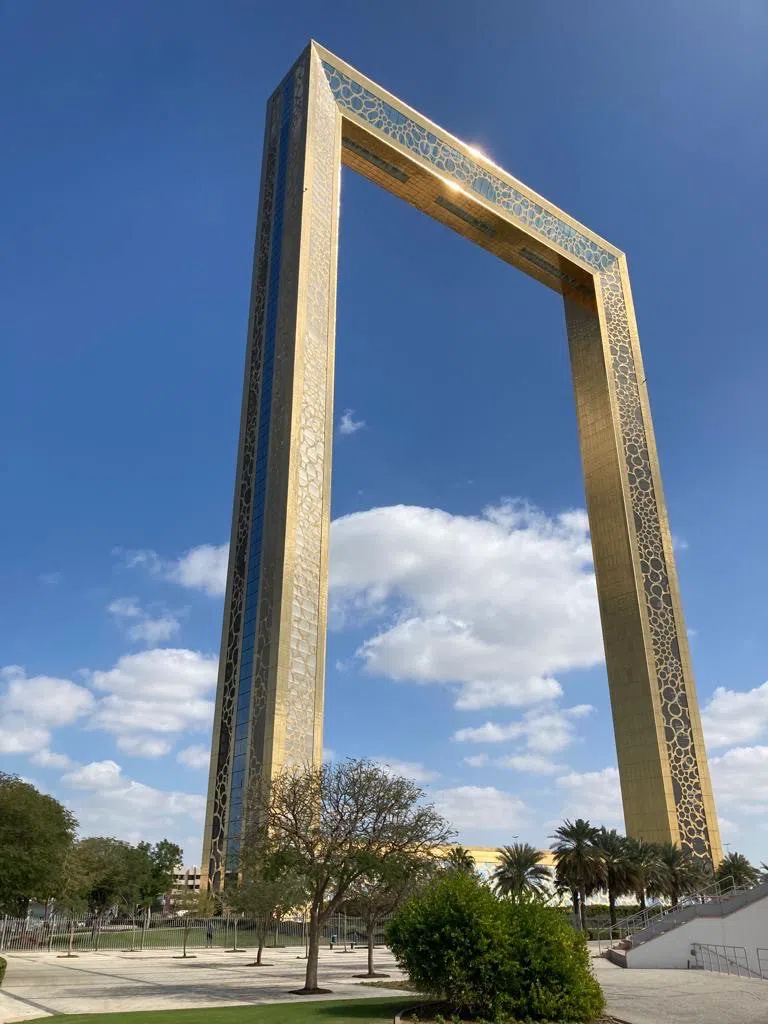
Hinge the second day on Dubai Frame (Zabeel Park, Al Kifaf), which sits between the two halves of the city and is reachable from Al Jafiliya metro. Adults pay AED 50 and children AED 20, it opens 09:00 to 21:00, and the glass bridge at the top is one-way, so groups stay together without effort. It opened in 2018 with a simple idea, old Dubai through one side and new Dubai through the other, and it delivers on that in about forty minutes. Treat it as a stop, not a morning.
From there go into Al Fahidi Historical Neighbourhood (Bur Dubai), free to wander at any hour and any group size. The coral-and-gypsum houses with wind towers were built by Persian merchants who settled along the Creek in the early twentieth century, and the towers are working air conditioning rather than ornament: stand under one in the heat and you feel the draught. The cultural centre runs guided heritage walks at roughly AED 90 to 120 and shared meals at around AED 150; both need booking for a party. Before you plan anything around it, note that Al Fahidi Fort, the old Dubai Museum, has been closed for restoration since 2021 and is not expected to reopen before 2027. Plan the district, not the museum.

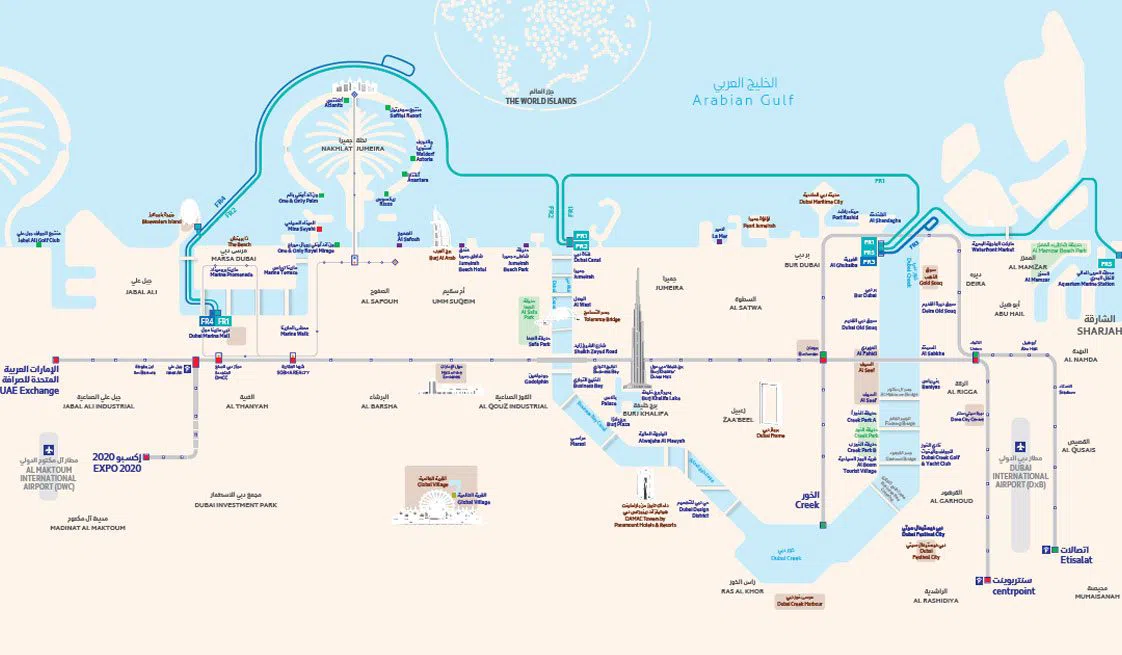
Then take the Dubai Creek abra crossing (RTA) (Bur Dubai to Deira), which is the cheapest good thing in the city and possibly the best. One dirham per crossing, two from Al Seef, paid in cash to the driver, on wooden boats holding about twenty people. Larger groups split across two abras or charter one outright for around AED 120 an hour. Five minutes on the water does what a forty-minute taxi loop around the Creek cannot, and you are sitting on the working continuation of a trade route that was dredged deeper from the late 1950s so bigger dhows could get in.
Land on the Deira side and walk into the Deira Gold Souk and Spice Souk (Deira). Public lanes, no door policy, gold sold at the daily rate plus a workmanship charge you should ask about before you fall in love with anything. Touts are persistent and get worse around a visibly touristy group; a flat, friendly no works better than avoiding eye contact. Arrive by boat rather than by car, because the Deira lanes are effectively undriveable in the evening, and the two souks are five minutes apart on foot.

Art in Al Quoz, then the Jumeirah coast

Day three runs along the coastal side of the city, and it starts inland. Alserkal Avenue (Al Quoz) is twenty-four galleries and independent spaces in one walkable compound of converted industrial units, open daily 10:00 to 19:00 and free to enter, with cafés at roughly AED 40 to 90. Individual galleries keep their own hours, so a Monday morning can feel half-shut while a weekend afternoon hums. It sits between Downtown and the beach strip, so it slots into a day rather than costing one. Go if you like contemporary art; skip it without guilt if you do not, because it is a working arts district rather than a spectacle.
Jumeirah Mosque (Jumeirah 1) is the one mosque in the city that runs open guided visits for non-Muslims, Saturday through Thursday but not Fridays, at about AED 45 per person including refreshments. Walk-ups register roughly thirty minutes before; groups should email ahead. The building went up in the 1970s in a Fatimid revival style, and the visit is a question-and-answer session as much as a tour: the guides invite the awkward questions, and the hour is better for it. Cover shoulders and knees; robes are lent at the door if you need them.

The beaches are ten minutes away. J1 Beach (Jumeirah 1) is the current name and layout of the site where La Mer stood before it was demolished, so treat any older recommendation for that name as out of date. It is a strip of beach clubs, which means minimum spends of roughly AED 300 to 800 per person for a day bed, group bookings taken in advance, and walk-ins that are hard at weekends. The line-up of clubs shifts, so check the specific one before you travel. Kite Beach (Umm Suqeim) is the opposite proposition and, for most people, the better one: free public sand, no door policy, showers and changing blocks every few hundred metres, food trucks along the back and a fourteen-kilometre running track behind them. It is the beach that works without a hotel day pass, with kids, or on an hour's notice.


The Palm as one day, not three separate trips
The fronds look like a driving route and behave like a cul-de-sac, so give Palm Jumeirah a single day and do everything on it. Land began going into the water here in 2001, and from ground level the shape is invisible, which is the entire case for The View at The Palm (Nakheel Mall, Palm Jumeirah). Timed entry starts from around AED 100 for non-prime slots and rises for sunset, with a fast-track upgrade available; groups booked in one transaction stay in one slot. It is the sane alternative to burning an afternoon driving the fronds to look for an angle that does not exist at sea level.

If you are travelling with children or teenagers, Atlantis Aquaventure (Palm Jumeirah) is the other half of that day and will eat all of it. Adults and over-eights pay AED 350, children aged three to seven AED 300, under-threes free, with group rates and Fast Pass upgrades available. It opens 10:00 to 18:30 with last entry at 17:30. Put it on the same day as the rest of the Palm rather than bolting it onto a Downtown morning, and use the monorail from the mainland gateway instead of the road if the queue looks discouraging.

An evening at Madinat and a night on the Marina strip
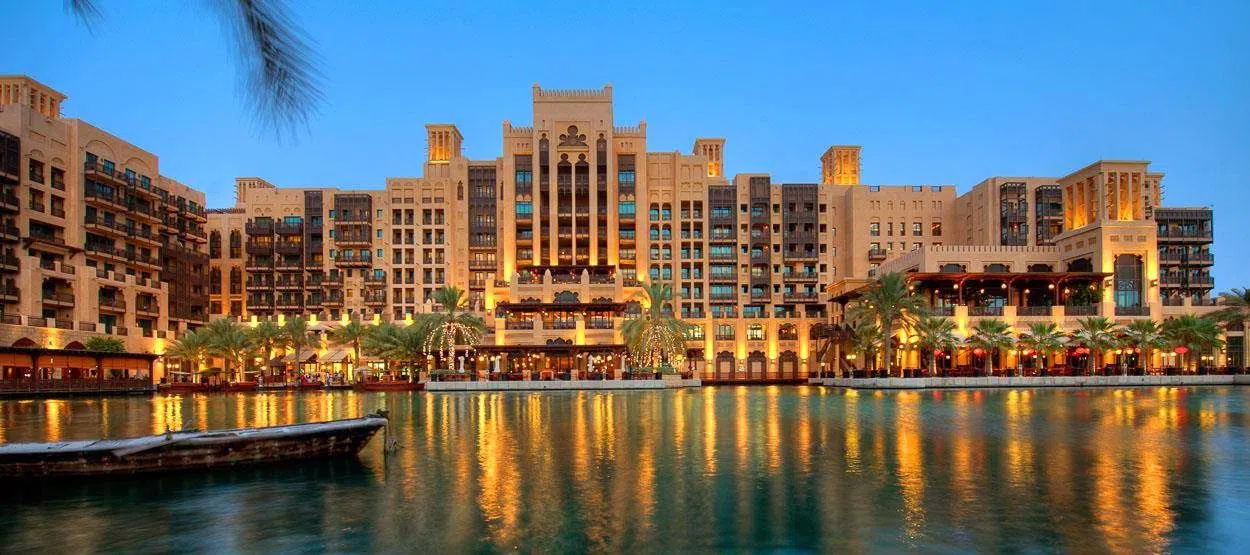
Madinat Jumeirah (Umm Suqeim) is free to walk into, and silent electric abras cross its 5.4 kilometres of canals. An abra tour runs roughly AED 75 to 100, dining across the souk lands anywhere from AED 150 to AED 400, and restaurants take group reservations. It also holds the best free view of the Burj Al Arab in the city, from a compound you never have to drive within. The wind towers here are early-2000s reconstruction rather than heritage, and the place is candid about that; it works as somewhere to eat and wander, not as history.
End the trip at The Walk and The Beach at JBR (Dubai Marina). Fully public, free, and served by both tram and metro, so an evening of beach, food and promenade costs no cross-city drive at all. Meals run about AED 80 to 250, restaurants along the strip seat large groups comfortably, and weekend tables should be booked. It is the most relaxed night out in the plan and the easiest one to improvise.

The one drive worth handing to somebody else

One trip is worth the road, and you should not be the one making it. Platinum Heritage (Dubai Desert Conservation Reserve) runs vintage Land Rovers at nine passengers a vehicle, with larger groups going out as a convoy and private vehicles bookable. Experiences cost roughly AED 450 to 1,200 per person depending on what you choose. It operates inside the conservation reserve with wildlife spotting and falconry rather than dune-bashing, which is a different and quieter kind of evening, and the pickup comes to your hotel, so the ninety minutes of desert road belongs to a driver who does it daily. Book it for the fourth or fifth night, when you have stopped needing to be anywhere at a fixed hour.
How the five days line up
Day one, Downtown on foot: tower slot, museum, fountain after dark. Day two, the Creek: frame in the morning, the old district, the abra across, the souks before the light goes. Day three, coast: galleries in Al Quoz, the mosque visit, an afternoon on the sand. Day four, the Palm, all of it, in one go. Day five, a slow morning, Madinat in the afternoon and either the Marina strip or the desert to close. Swap freely, but keep the clusters intact, because the plan works on what it refuses to combine.
Money, timing and getting about
Buy a Nol card at any metro station and top it up once; it covers the metro, the tram and public buses. Trains run roughly from 05:00 to around midnight, later on Friday and Saturday nights and with a later start on Sunday, so check the day you need rather than assuming. Taxis are metered, plentiful and cheap by international standards, and ride-hailing works everywhere; the failure mode is not cost but the 17:00 to 20:00 window, when a fifteen-minute hop becomes forty-five.
Cards work almost everywhere, with three exceptions worth carrying cash for: the abra driver, small souk purchases and food trucks. The UAE weekend falls on Saturday and Sunday, so Friday afternoons are quieter and attractions are busiest at weekends; book the museum and the tower for a weekday if you can. Between October and April the weather is the reason to come; from June to September the outdoor half of this plan stops being pleasant and the malls fill up.
On budget, the shape is unusual: the free half of the city is very good. Two people can do the Creek day, both beaches, Alserkal Avenue, Madinat and a JBR evening for the price of meals. The costs concentrate in three places: the tower, the waterpark and the desert. Any one of the three can be cut without gutting the trip. Dress modestly away from the beach and the resorts, expect drinking to be licensed-venue only, and if you want more detail on where to eat and stay by area, the wider Dubai guide goes deeper than a five-day plan can.
Before you go
Where should I stay in Dubai to avoid long drives?
Base yourself within a walk of a Red Line metro station. Downtown works for a city-first trip, with the tower, the fountain and the museum walkable or one stop away. The Marina and JBR work for a beach-first trip, with the tram along the strip and the metro inland. Avoid Palm Jumeirah unless you are staying inside a resort, since one road runs on and off it.
Do I need a car for five days in Dubai?
No. The metro, tram, abras and short taxi hops cover everything in this plan. The desert trip is the one exception, and operators like Platinum Heritage collect you from your hotel, so you are not the one driving. Ride-hailing and metered taxis fill any gaps cheaply, though a fifteen-minute hop can take three times as long between 17:00 and 20:00.
Is the sunset slot at Burj Khalifa worth the extra money?
Only if you want the ritual. Prime sunset slots start at AED 379, against AED 179 to 199 for non-prime entry on levels 124 and 125, and the light everyone photographs is also the light dust is most likely to soften. A clear late morning often shows more coastline for half the price. Either way, book days ahead and walk in through Dubai Mall rather than driving.
Can I still visit the Dubai Museum in Al Fahidi?
No. Al Fahidi Fort, which housed the old Dubai Museum, has been closed for restoration since 2021 and is not expected to reopen before 2027. The surrounding Al Fahidi Historical Neighbourhood is free to walk at any hour, and the cultural centre runs guided heritage walks at roughly AED 90 to 120 and shared meals at about AED 150, both bookable for groups.
Which Dubai beach works without paying for a club or day pass?
Kite Beach in Umm Suqeim. Entry is free and there is no door policy. Showers and changing blocks sit every few hundred metres, with food trucks and a fourteen-kilometre track behind the sand. For the club version, J1 Beach in Jumeirah, which replaced the demolished La Mer, has minimum spends of around AED 300 to 800 per person and difficult walk-ins at weekends.